ClientaSepidar System

Clienta cloud · Windows agent · local Sepidar

Sepidar accounting integration

Connect Clienta to Sepidar

Enter the sale once. Let the same document land in Sepidar.

Clienta is cloud software. Sepidar runs on Windows inside the company. Without a bridge, sales types twice, cannot see a balance, and a CRM invoice is not a finance document. The marketplace connector closes that gap: catalog and parties come from accounting, issued invoices go to Sepidar, and credit and stock appear on the customer record.

This page explains how the connection works. It is not a substitute for the in-product guide. Setup is done by the accountant and a workspace admin together. Salespeople only see the result on invoices and the finance card.

  • Outbound agent; do not open a port to the internet
  • Sepidar passwords stay on the Clienta server
  • Official invoices lock after send
An issued Clienta invoice: what gets posted to Sepidar

How the model works

Sepidar stays the source of truth for price and stock. Clienta stays the source of truth for selling.

This is not full accounting sync. Sepidar’s web service is built for CRM and ordering: customers, read-only items, quotes, sales invoices, receipts and stock. The ledger and tax e-invoicing are not in that API, and Clienta does not claim them.

Sepidar → Clienta

Catalog, remainder, credit, stock

Sellable items sync with code, tax and default-warehouse quantity. Account remainder and credit limits are read onto a person or company. List price is the source of truth.

  • Finance creates items in Sepidar
  • Manual sync or automatic every ten minutes
  • Stock is the warehouse set on the connection
  • Balances without sales opening Sepidar

Clienta → Sepidar

Parties, quotes, invoices, receipts

A person or company is linked or created as a Sepidar customer. Only issued documents are sent. A receipt can be registered on a synced invoice.

  • Drafts are not sent to Sepidar
  • Credit-limit warning before posting
  • Every line must be a synced item
  • Official invoices cannot be edited from CRM

Without a connector

Why Sepidar companies ask every CRM for this connection

Didar, Sarv, Payam Gostar and Vtiger all built a “connect to Sepidar” page because demand outruns the technical friction. The pain is the same: sales in the cloud, accounting on Windows, nothing in the middle.

Sepidar is not on the public internet

The service listens on localhost:7373. A cloud CRM cannot reach it without an agent or VPN. Opening the port on a modem puts accounting on the internet.

Item codes do not match across systems

If matching is a spreadsheet exercise, invoices fail on unknown items. Clienta pulls items from the API so Sepidar remains the code source of truth.

An invoice will not post without a valid party

Individuals and companies have required fields. The connector maps the person or company to a Sepidar customer before the document.

Sales should not void a tax invoice

In Iran a sales invoice has consequences. A serious product has roles: sales raises the quote, finance or an admin posts the official invoice.

A dropped connection must be obvious

If Sepidar is closed or the agent is offline, live sync stops. Clienta should say so — the send button must not fail silently.

What the connector does

What you actually see after it is connected

A finance card on the customer and the invoice

Remainder, credit, connection status and send live where the salesperson works — not in a separate IT panel.

Credit-limit warning

If posting would push the remainder past Sepidar credit, the document is not created. Finance is not told after the fact.

Item sync

Sellable items enter the workspace catalog. New items are created by finance in Sepidar and synced again.

Posting defaults

Default sale type, warehouse and currency are read from Sepidar itself. Without them the document is rejected — the form is not left empty.

Who may send invoices

You can allow only the workspace admin to send official invoices, or anyone who can issue an invoice in Clienta.

An agent without PowerShell

The Windows installer registers a service. You drop the connection file on the wizard. No command line.

Marketplace

Add the app to the workspace first. Then the connection and agent tabs appear.

A workspace admin adds Sepidar from the marketplace. Ordinary members do not get that button. After adding it you are not connected yet — the app is only enabled so you can finish serial, user and agent.

  • Add Sepidar to the workspace for free
  • Help, connection, defaults, items and agent tabs
  • Password and serial stored only on the server
Clienta marketplace: this is where the Sepidar connection starts

Invoices

Send is for issued documents, not a draft on a salesperson’s desk.

You build the invoice in Clienta, check synced lines and issue it. After send, the Sepidar number stays on the document and CRM editing closes.

  • Only issued status goes to Sepidar
  • A line without a mapped item is blocked
  • Deleting in CRM does not delete the Sepidar document
Clienta invoices: the working bridge between sales and Sepidar

Deals

A won opportunity should become an invoice, not a message to the accountant.

Sepidar has no deal object. The Clienta board moves selling forward; when the opportunity is won, the invoice is built from those lines and sent if you configured it.

  • Pipeline stages are not synced — they do not need to be
  • The invoice stays on the deal and the customer
  • Auto-send after issue is optional
Clienta deal record: where selling turns into a document

Sales reports

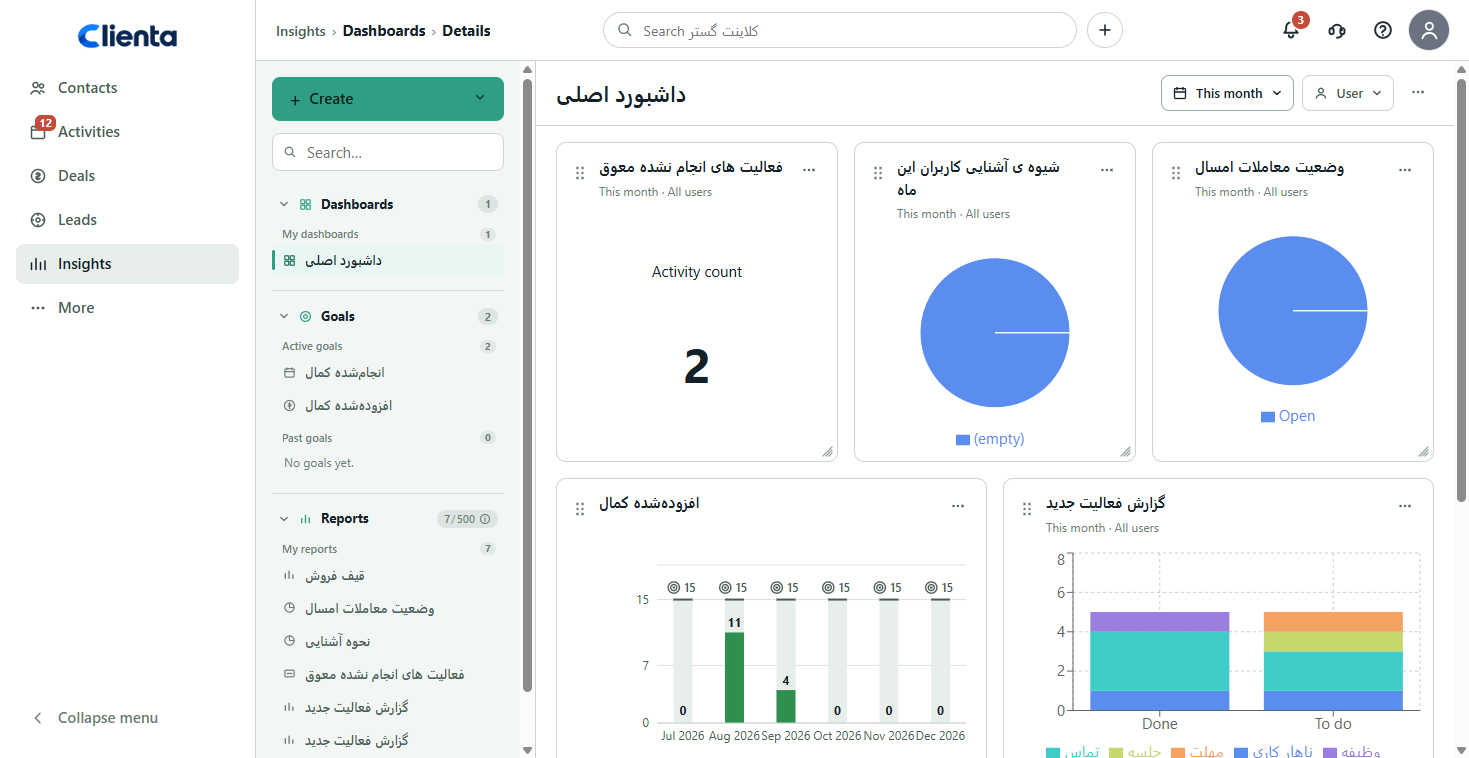
When items and parties match, sales reports start matching finance.

Report drift is usually two catalogs and two customers, not a missing chart. The connector unifies the source so the Clienta funnel and the Sepidar invoice talk about the same lines.

  • One item code in both systems
  • One party for individuals and companies
  • Quotes and invoices visible on the funnel path
Clienta sales dashboard when data is aligned with Sepidar
Clienta sales dashboard: selling numbers from the Sepidar catalog

Setup at a glance

Finish the Sepidar work before you fill the Clienta form

A salesperson cannot create the lock and device in Sepidar alone. This order is the same path the in-product guide covers in more depth.

  1. 1

    Web-service lock

    Ask the reseller to enable the Sepidar CRM web service — or shop / mobile-ordering — on the company’s dongle. Clienta does not sell that lock.

  2. 2

    Server mode

    Log in as admin, tick server mode and start the service on port 7373. Do not close Sepidar or let the PC sleep.

  3. 3

    A Clienta device

    In ordering, create a clearly named device, attach a user who can register invoices and copy the 8-character serial. Do not click “get serial” after you are connected.

  4. 4

    Windows agent

    Run the installer on the Sepidar PC, download the connection file from Clienta and drop it on the wizard. The agent should go online.

  5. 5

    Connect, defaults, items

    Enter serial and user in Clienta, pick sale type, warehouse and currency from Sepidar lists, then sync items. Sending invoices now makes sense.

Architecture

An outbound agent. Not an open port on the internet.

Almost every Iranian company should pick the agent. Direct URL is only right when the Clienta server can already reach the Sepidar network — for example an internal VPN. Do not open port 7373 on the modem unless IT has done that with HTTPS and a firewall.

Clienta cloud

Sync jobs, issued invoices and the agent token. The Sepidar password is encrypted on the server.

Agent on the Sepidar PC

Connects outbound, pulls work and posts to http://127.0.0.1:7373. Do not run it on a salesperson laptop.

Sepidar web service

Device + user + GenerationVersion. Every request needs a fresh id. The token is valid after login.

A new token revokes the previous one. If the agent goes offline, keep Sepidar running in server mode, do not shut the PC down, and download a fresh connection file if needed.

Daily work

Sending an invoice should check credit before a document exists.

The Sepidar card on an issued invoice is the send button. If an item is unmapped, the customer is missing or credit is exceeded, the message is explicit. After success, the invoice stays locked in CRM.

Honest product

This is a sales connector, not two-way ERP.

What this version reads and writes

  • Reads sellable items, units, warehouses, sale types and currencies.
  • Creates or links individual and company customers.
  • Posts issued quotes and invoices.
  • Reads remainder, credit and stock for display in CRM.
  • Can send a receipt on a synced invoice.

Left out on purpose

  • Items are not created in Sepidar from CRM.
  • Official invoices are not edited or deleted from CRM after send.
  • Warehouse transfers, sales returns and hot/cold distribution are not in this version.
  • Sepidar cloud, the general ledger and tax e-invoicing are not covered.
  • If the server mode or agent is off, live sync does not run.

Who does what

Setup is a two-person job. Daily use belongs to sales.

Accountant / Sepidar admin

Lock, server mode, device, web-service user, sale type and warehouse. Without these the Clienta form errors. They also create new items in Sepidar.

Clienta workspace admin

Add the app, create the agent token, enter serial and user, set who may send invoices and run the first item sync. Ordinary members do not have these actions.

Salesperson

After connection, Clienta only. They build quotes, see balances and issue invoices if the role allows. Sepidar is not on their desk.

FAQ

Technical questions people ask before connecting Sepidar

How does the Clienta–Sepidar connection work?

Sepidar exposes a local web service on the company Windows PC. Clienta is cloud software, so a Windows agent on that same PC pulls work from the cloud and posts to localhost. Items and balances are read; issued quotes and invoices are written.

Do I need a static IP or an open 7373 port?

Not on the recommended path. The outbound agent connects from inside the network. Opening the accounting port on a modem is not recommended. A direct URL only makes sense if the Clienta server can already reach your network.

What is the Sepidar web-service lock?

Without the Sepidar CRM web-service lock — or shop / mobile-ordering — there is no port and no API. A Sepidar reseller enables it on the company’s hardware dongle. It is not the tax e-invoicing module.

Why did my Clienta invoice not post in Sepidar?

Usually one of: the invoice is still a draft, a line is not mapped to a synced item, default sale type or warehouse is empty, the customer is unmapped, credit is exceeded, or the agent is offline. The error in Clienta names the cause.

Can I edit a sent invoice in Clienta?

No. After send, the official invoice locks in CRM. Corrections and voids happen in Sepidar. Deleting in Clienta does not remove the Sepidar document. That limit is intentional so finance keeps ownership.

Can I create items in Sepidar from Clienta?

No. The official Sepidar API does not create items from outside. Finance defines the item in Sepidar and Clienta syncs it. Without a valid item, the invoice will not post.

Which PC should run the agent?

The same machine that runs Sepidar in server mode — usually the accounting server, not a salesperson laptop. The agent must reach http://127.0.0.1:7373.

Where is the Sepidar password stored?

Only on the Clienta server, encrypted. It is not shown again in the browser. To change user or device, reconnect.


Send one test invoice to Sepidar.

Open the 14-day trial, add Sepidar from the marketplace and connect on the company’s real accounting PC with your accountant. The step-by-step guide lives inside the product.