ClientaHesabfa

Clienta cloud · Hesabfa REST · no Windows agent

Hesabfa cloud accounting integration

Connect Clienta to Hesabfa

Enter the sale once. Let the same document land in Hesabfa.

Clienta is cloud software. Hesabfa is cloud software too. Without a bridge, sales types twice, cannot see a balance, and a CRM invoice is not a finance document. The marketplace connector closes that gap: catalog and parties come from accounting, issued invoices go to Hesabfa, and credit and stock appear on the customer record.

This page explains how the connection works. It is not a substitute for the in-product guide. Setup is done by the Hesabfa business owner and a workspace admin together. Salespeople only see the result on invoices and the finance card. Didar, CRM24 and Vtiger all sell the same bridge because demand outruns the technical friction.

  • Two keys; no Windows agent
  • The owner password is never stored
  • Official invoices lock after send
An issued Clienta invoice: what gets posted to Hesabfa

How the model works

Hesabfa stays the source of truth for price and stock. Clienta stays the source of truth for selling.

This is not full accounting sync. Hesabfa’s API is built for CRM and shops: contacts, items, sales invoices, receipts and stock. The ledger and tax e-invoicing are not in this connector, and Clienta does not claim them. Tax e-invoicing stays inside Hesabfa.

Hesabfa → Clienta

Catalog, remainder, credit, stock

Active items and services sync with code, sell price and stock. Account remainder and credit limits are read onto a person or company. Hesabfa price is the source of truth.

  • Finance creates items in Hesabfa
  • Manual sync or automatic every ten minutes
  • Stock is Hesabfa Stock
  • Balances without sales opening Hesabfa

Clienta → Hesabfa

Contacts, quotes, invoices, receipts

A person or company is linked or created as a Hesabfa contact. Only issued documents are sent. A quote becomes a draft; an invoice becomes confirmed.

  • Clienta drafts are not sent to Hesabfa
  • Credit-limit warning before posting
  • Every line must be a synced item
  • Official invoices cannot be edited from CRM

Without a connector

Why Hesabfa businesses ask every CRM for this connection

Didar announced a free Hesabfa connection, CRM24 sells it as a one-time fee, and Vtiger lists Hesabfa beside Sepidar and Holoo. The pain is the same: sales in CRM, accounting in Hesabfa, nothing in the middle — even though both are already on the internet.

The market expects “two keys and done”

Hesabfa is on the internet. If Clienta repeats Sepidar friction here, it loses to Didar. The connection has to come up in under thirty minutes or it stays “later”.

Item codes do not match across systems

If matching is a spreadsheet exercise, invoices fail on unknown items. Clienta pulls items from the API so Hesabfa remains the code source of truth.

An invoice will not post without a valid contact

Individuals and companies have required fields. The connector maps the person or company to a Hesabfa contact before the document.

Sales should not void a tax invoice

In Iran a sales invoice has consequences. A serious product has roles: sales raises the quote, finance or an admin posts the official invoice.

A single hook collides with the shop

Many Hesabfa customers also run WooCommerce. Hesabfa allows only one hook URL. If Clienta silently takes it, the shop sync dies.

What the connector does

What you actually see after it is connected

A finance card on the customer and the invoice

Remainder, credit, connection status and send live where the salesperson works — not in a separate IT panel.

Credit-limit warning

If posting would push the remainder past Hesabfa credit, the document is not created. Finance is not told after the fact.

Item sync from the API

Active items and services enter the workspace catalog. New items are created by finance in Hesabfa and synced again.

A quote is a Hesabfa draft

Hesabfa has no separate quotation entity. A Clienta quote becomes a draft sales invoice; the official invoice becomes confirmed.

Who may send invoices

You can allow only the workspace admin to send official invoices, or anyone who can issue an invoice in Clienta.

Polling by default; hook optional

Changes are read with getChanges so WooCommerce is not displaced. A live hook is only used if you confirm the replacement.

Marketplace

Add the app to the workspace first. Then the connection tab appears.

A workspace admin adds Hesabfa from the marketplace. Ordinary members do not get that button. After adding it you are not connected yet — the app is only enabled so you can paste the API key and login token.

  • Add Hesabfa to the workspace for free
  • Help, connection, posting defaults and items tabs
  • Keys stored only on the server
Clienta marketplace: this is where the Hesabfa connection starts

Invoices

Send is for issued documents, not a draft on a salesperson’s desk.

You build the invoice in Clienta, check synced lines and issue it. After send, the Hesabfa number stays on the document and CRM editing closes.

  • Only issued status goes to Hesabfa
  • A line without a mapped item is blocked
  • Deleting in CRM does not delete the Hesabfa document
Clienta invoice: the practical bridge between sales and Hesabfa accounting

Deal

A won opportunity should become an invoice, not a message to finance.

Hesabfa has no deal entity. The Clienta board moves selling forward; when the opportunity is won, the invoice is built from those lines and sent if you configured auto-send.

  • Pipeline stage is not synced; it does not need to be
  • The invoice stays on the deal and the customer
  • Auto-send after issue is optional
Clienta deal record: where selling turns into a document

Sales reports

When items and contacts match, sales reports match finance.

Report drift usually comes from two catalogs and two customers, not from missing charts. The connector unifies that source so the Clienta pipeline and the Hesabfa invoice speak the same lines.

  • One item code in both systems
  • One contact for individuals and companies
  • Quotes and invoices visible on the pipeline path
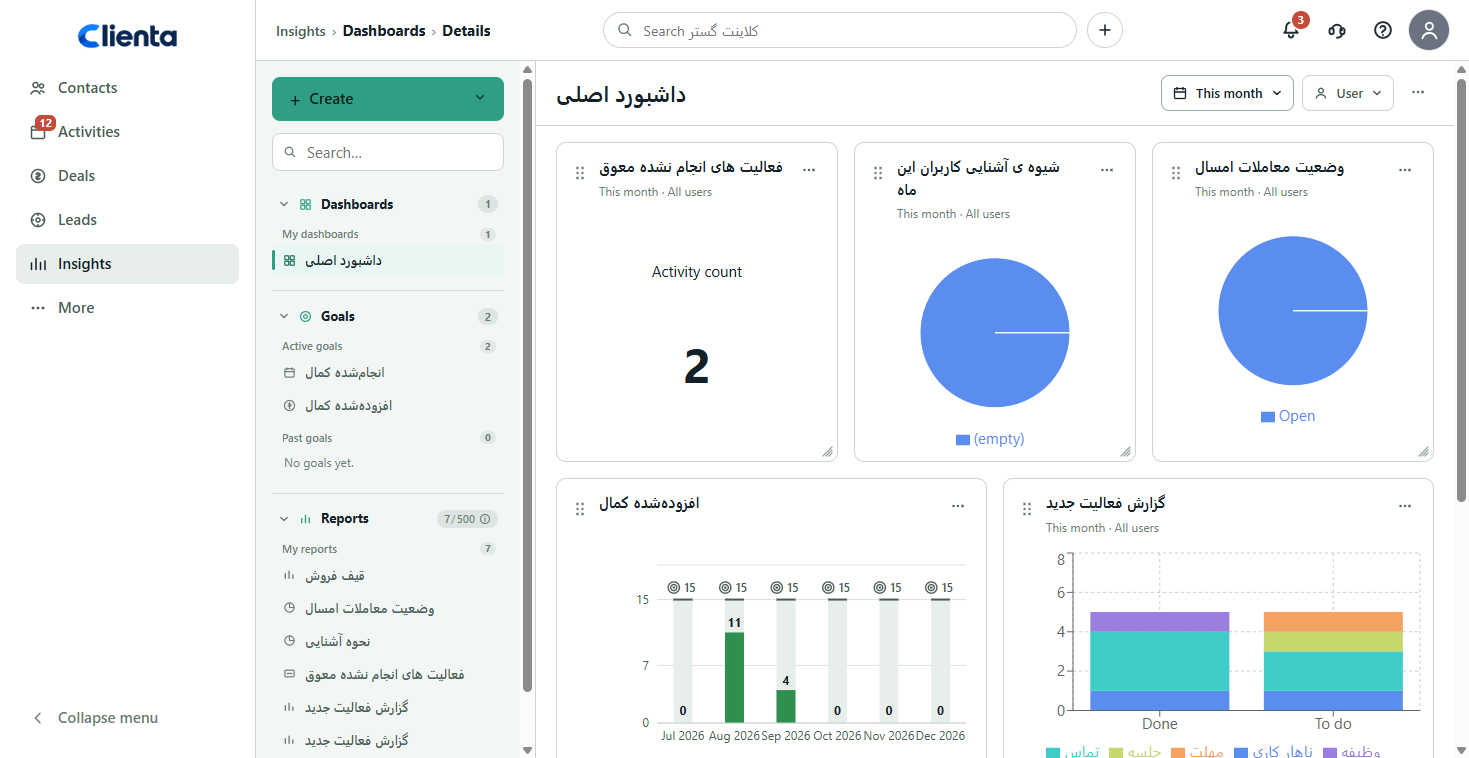
Clienta sales dashboard when data is aligned with Hesabfa
Clienta sales dashboard: the number when it comes from the same Hesabfa catalog

Setup at a glance

Take the keys from Hesabfa. The rest is in Clienta.

A salesperson usually cannot open Hesabfa finance settings. This order is what the in-product guide explains in more detail. If the business is active, it usually takes 15 to 30 minutes.

  1. 1

    Turn the Hesabfa API on

    Sign in as the business owner, open finance settings and the API page, and make sure the API is on. If it is off, Clienta shows “API is disabled”.

  2. 2

    API key and login token

    Copy both from that page. The login token replaces username and password. Do not enter the owner password in Clienta.

  3. 3

    Add the app to the workspace

    A workspace admin adds Hesabfa from the marketplace. Until the app is added, the connection tab is hidden.

  4. 4

    Paste the keys and test the fiscal year

    Paste the key and token on the connection tab. If the fiscal year name appears, you are on the right business. An expired subscription shows up here, not as a vague “API is broken”.

  5. 5

    Posting defaults and item sync

    Agree currency, warehouse receipt and issuer role with finance, then sync items. Sending invoices now makes sense.

Architecture

Cloud to cloud — no open port and no Windows agent

The Clienta server POSTs directly to the Hesabfa REST API. That is why setup is simpler than on-premises Sepidar. Keys live only on the backend, encrypted. Live sync uses getChanges polling; the hook is an optional accelerator.

Clienta cloud

The sync queue, issued invoices and encrypted keys. The business-owner password is never stored.

api.hesabfa.com

Every method is POST and JSON. Rate limit 240 requests a minute. A unique id stops a duplicate post within 24 hours.

Hesabfa business

Fiscal year, Contact, Item, Invoice. Tax e-invoicing and the ledger stay here.

If you are told the change hook is already set for another system, do not tick replace unless you want WooCommerce or that system disconnected. Clienta polling still works without the hook.

Daily work

Sending an invoice should check credit before the document exists.

The Hesabfa card on an issued invoice has the send button. If an item is unmapped, the customer is missing or credit is full, the message is clear. After success, the invoice stays locked in CRM.

Product honesty

This is a sales connector, not a two-way ERP.

What this version sends and reads

  • Reads active items and services, units, sell price and stock.
  • Creates or links individual and company contacts.
  • Posts an issued quote as a Hesabfa draft.
  • Posts an issued sales invoice as confirmed.
  • Reads remainder, credit and stock for display in CRM.

Deliberately left out

  • Items are not created in Hesabfa from CRM.
  • Official invoices are not edited or deleted from CRM after send.
  • Warehouse transfers, sales returns and manufacturing are not in this version.
  • Tax e-invoices are not issued from CRM; that is Hesabfa’s job.
  • Multiple Hesabfa businesses on one workspace are not in this version.

Who does what

Setup is a two-person job. Daily use is the salesperson’s job.

Hesabfa business owner

Turns the API on and creates the key and token in finance settings. Without those the Clienta form errors. They also create new items in Hesabfa.

Clienta workspace admin

Adds the app, pastes the keys, sets who may send official invoices and runs the first item sync. Ordinary members do not get those jobs.

Salesperson

After connection, only Clienta. They raise quotes, see balances and issue invoices if the role allows. Hesabfa is not on their desk.

FAQ

Technical questions asked before connecting Hesabfa

How does the Clienta–Hesabfa connection work?

Hesabfa has a cloud REST API at api.hesabfa.com. Clienta connects with an API key and login token. Items and balances are read; an issued quote is written as a draft and an issued invoice as confirmed.

Do I need a Windows agent or an open port?

No. Hesabfa is on the internet. The Clienta server reaches the Hesabfa API from the cloud. That is the main difference versus on-premises Sepidar.

Where do I get the API key?

In Hesabfa, sign in as the business owner and open Settings → Finance settings → API. The apiKey is unique per business and the loginToken replaces a password. Official docs: hesabfa.com/help/api.

Why did the Clienta invoice not register in Hesabfa?

Usually one of these: the invoice is still a draft, a line is not mapped to a synced item, the customer is unmapped, credit is full, the API is off, the business expired, or the 240-request limit was hit. The Clienta error names the cause.

Can I edit a sent invoice in Clienta?

No. After send, the official invoice is locked in CRM. Correction and voiding happen in Hesabfa. Deleting in Clienta does not remove the Hesabfa document. That limit is intentional so finance keeps the document.

Can I create items in Hesabfa from Clienta?

The Hesabfa API can create items, but this Clienta version does not, so finance keeps codes and stock. The accountant defines the item in Hesabfa and Clienta syncs it.

What if WooCommerce is already connected to Hesabfa?

The Hesabfa change hook is a single URL. Clienta polls by default. Do not tick replace-hook unless you have coordinated with the shop.

Where is the Hesabfa password stored?

It is not stored. Only the API key and login token live on the Clienta server, encrypted. They are not shown again in the browser. To change business, reconnect.


Send one test invoice to Hesabfa.

Open the 14-day trial, add Hesabfa from the marketplace and paste the keys with the business owner. The step-by-step guide lives inside the product.